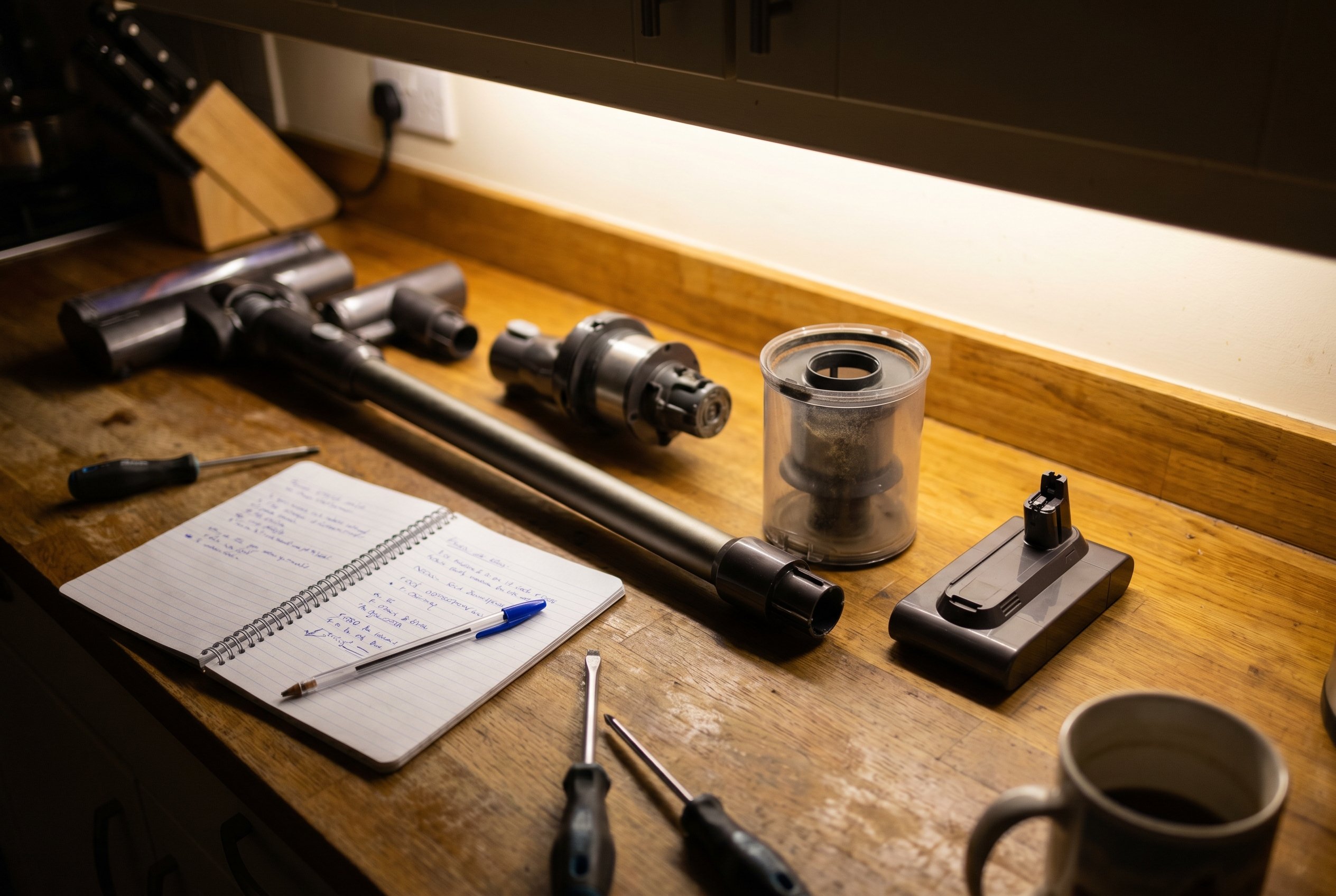
The first one died at 16 months.
It was the British brand. The one everyone's heard of. The one with the laser light that's all over Instagram. I paid $649 for it in late 2022, and by spring of 2024 the battery couldn't hold a charge for more than six minutes. A replacement battery, direct from the manufacturer, was quoted at $109. Plus shipping. Plus a four-week wait.
I returned the email. I bought a different one.
The second was a different brand entirely. Different country of origin, different design philosophy, different price tier — $479 instead of $649. I figured I'd been unlucky the first time. I figured the cheaper one would at least be honest about being cheaper.
It died at 19 months.
Same symptoms. Battery degradation, then a clogged-airway warning that wouldn't go away no matter how many times I disassembled the thing, then it just stopped powering on one Tuesday morning while I was vacuuming the entry rug.
That was the moment I sat down on the floor — vacuum in pieces around me, battery indicator dark, dog watching me from the hallway — and I did what I should have done the first time.
I got curious instead of angry.
I'm not a journalist. I spent eleven years as a product buyer for a regional housewares chain before I left to do this kind of work independently. I know how product categories are designed. I know what "engineered to a price point" means when you read it on a spec sheet. And I had a hunch that what I was looking at wasn't bad luck.
So I gave myself a month. I read engineering forums until my eyes hurt. I called two appliance repair technicians and asked them point-blank what they were seeing on their benches. I bought a teardown kit from iFixit and disassembled my dead vacuum on my actual kitchen counter, screw by screw, with a flashlight.
What I found wasn't a conspiracy. It was something worse. It was a category-wide design pattern that nobody is going to admit to on a marketing page, because if they did, the entire premium cordless vacuum industry would lose half its sales overnight.
Here's what I found.
What I Found
I want to be careful with how I present this, because I'm not interested in conspiracy theories and I'm not here to call any specific brand a fraud. What I'm describing below is a pattern — a set of design choices that appear, with remarkable consistency, across most of the premium cordless vacuum category in 2024 and 2025.
You can decide for yourself what to do with it.
The $3 Part That's Missing From Your $700 Vacuum
The first thing I learned, courtesy of a teardown video and a long conversation with an electronics repair tech in Pennsylvania, is that the battery packs inside most premium cordless vacuums are not what you think they are.
They are not single batteries. They are assemblies of 6 to 8 individual lithium-ion cells wired together — the same kind of cells you'd find in a power drill or an e-bike.
Here's the thing nobody mentions: in any multi-cell battery pack, those cells drift apart in voltage over time. One cell ages slightly faster than the others. Without a small piece of circuitry called a cell-balancing controller, that one weak cell will drag the whole pack down — and the vacuum's onboard electronics will mark the entire battery as "defective," even though five of its six cells are still perfectly healthy.
I won't name names here, because the engineering forums where this has been documented use serial numbers and teardown photos rather than press releases. But the pattern is consistent enough that one independent technical blog described it bluntly: the battery isn't dying. The battery is being told it died.
The repair tech I spoke with put it more simply.
Glue Where Screws Used to Be
I took my dead vacuum apart on the kitchen counter. It took me forty minutes and a flathead screwdriver I had to bend slightly to fit into one of the seams.
When I got it open, I understood why it took forty minutes.
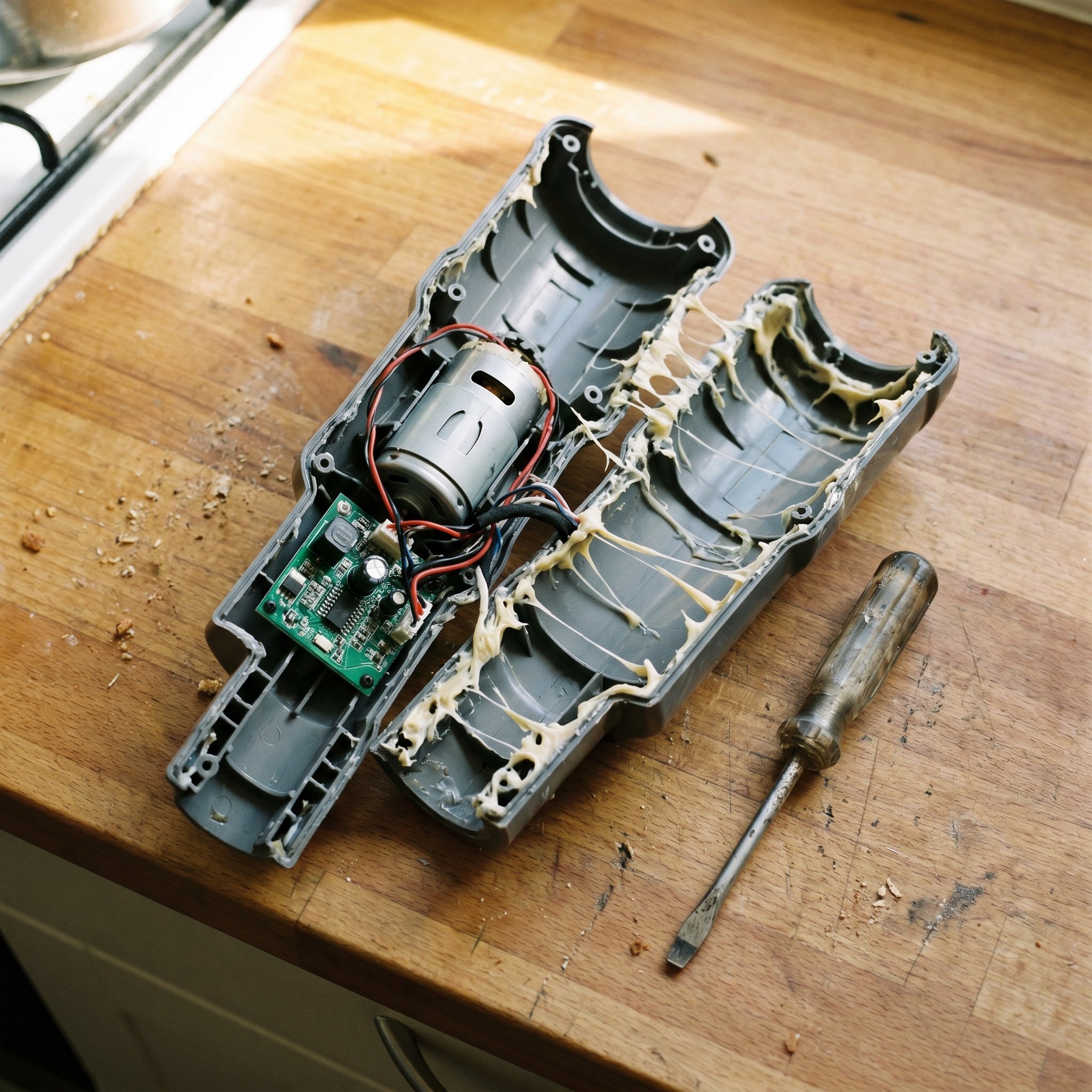
Half the housing was glued.
Not all of it. The visible screws on the outside were real screws. But the internal assemblies — the motor housing, the cyclone chamber, the battery compartment lid — were held together with what a manufacturing engineer on a forum I'd been reading described as "permanent adhesive joints."
I called the manufacturer's customer service line to ask whether the battery compartment was designed to be user-serviceable. The representative was polite. She told me that "battery replacement requires a certified service center" and quoted me a price of $189 plus shipping both ways for the service.
The vacuum had cost $479 new. The battery service quote was 40% of that.
I did not send it in.
The Two-Year Battery Shape Change
This one I found by accident.
I was looking for replacement batteries for my dead vacuum online — third-party ones, since the manufacturer's was so expensive. The vacuum was a 2022 model. I found one listing that looked correct, ordered it, and waited.
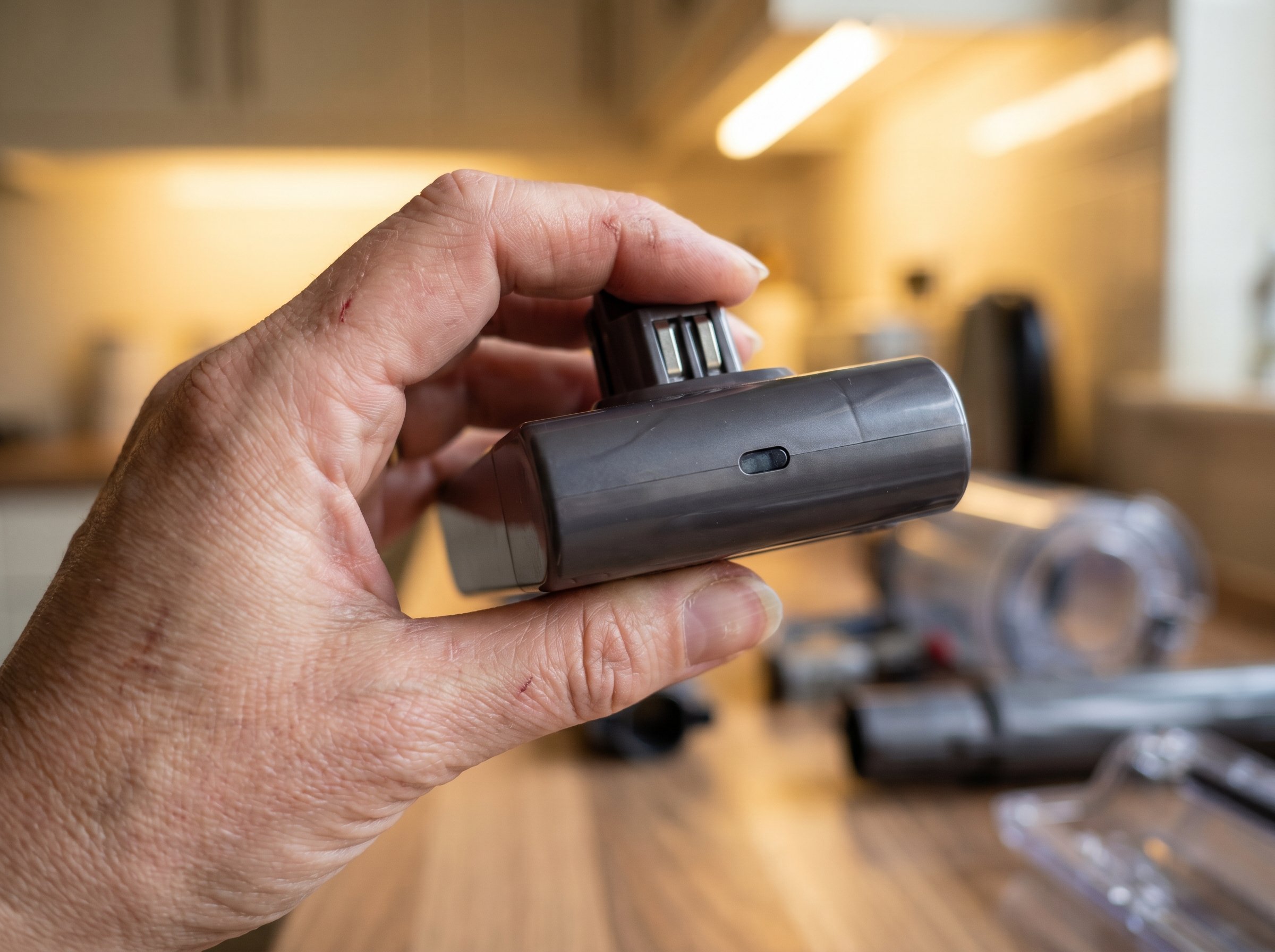
What arrived didn't fit.
It was the correct part number for the 2022 model. But the seller's photos, which I had glanced at quickly, were showing a slightly different-shaped pack. I called the seller, who was apologetic and explained that the manufacturer had revised the battery housing three times in two years. The 2022 pack and the 2024 pack are not interchangeable, even though the vacuums look nearly identical from the outside.
I checked. He was right. The 2022 pack is no longer being manufactured.
The vacuum is two and a half years old.
I don't know whether this is a deliberate design choice or an unintentional side effect of how product lines evolve. What I know is that the practical result is the same: a 2.5-year-old vacuum whose original battery has died cannot be repaired with a current-production replacement.
That is a thing that is happening, and it is happening repeatedly, across multiple brands in this category.
The Warranty Fine Print Nobody Reads
The last finding is the one that genuinely upset me, because it required me to dig into a document I had agreed to without reading three years ago.
One of the major American vacuum brands — a household name, you would know it instantly — has a warranty clause that requires the brushroll to be replaced every 90 days in order for the warranty to remain valid. The brushroll is a $35 to $45 part.
I want to be fair: this is disclosed. It is in the warranty document. The owner agreed to it when they registered the product.
But I read product manuals for a living for over a decade, and I had not encountered this specific clause before I went looking for it. It is not on the box. It is not on the manufacturer's product page. It is in a PDF, on page 14 of 22, in a typeface roughly the size of the words "and/or" in a credit card agreement.
I sat with all of this for a few days before I figured out what I wanted to do with it.
I didn't want to write a hit piece on any individual brand. That's not what this is. The story isn't one company being deceptive. The story is that the entire premium cordless vacuum category has converged on a set of design choices that make these machines disposable — and the marketing has not caught up to that fact yet.
Which meant: if I was going to buy another cordless vacuum, I was going to buy a different kind of cordless vacuum entirely.
So I made a list.
What I Would Require
I sat at my kitchen table on a Saturday morning and wrote down, in a notebook, every single requirement I would have for any cordless vacuum I'd ever buy again. Not features I wanted. Requirements. Non-negotiable. If a vacuum didn't have all of these, I wasn't buying it.

Here is what I came up with, in order of importance:
A replaceable battery, with no glue. If the battery is the part most likely to fail, it should also be the part easiest to replace. This eliminates roughly 90% of the premium cordless category.
Standard cell chemistry. No proprietary battery shape. No "must be purchased from manufacturer." If the cells inside the pack are standard 18650 or 21700 lithium-ion (the same cells used in every power tool on the market), then third-party replacements will always be available, even if the brand goes out of business.
A real warranty written in plain English. Not a 22-page PDF. Not a "subject to terms and conditions" clause that hides a 90-day brushroll requirement on page 14. A warranty I can read in 60 seconds and understand without a lawyer.
Under five pounds. Both of the vacuums that died on me weighed close to seven pounds. By the end of vacuuming the stairs, my forearm was burning. I'm 44 years old. I am not interested in turning my house chores into upper-body training.
An anti-tangle brush head. I have a shedding dog and shoulder-length hair. Both of my dead vacuums required a weekly ritual involving scissors and frustration.
A trigger lock. I should not have to hold a button down for twenty minutes to vacuum my living room. This is not a power tool. The fact that premium brands force you to maintain a death grip on the handle for the entire cleaning session is a design choice that suggests their engineers do not use their own products.
An honest runtime claim. If the box says 60 minutes, I should get 60 minutes — not 60 minutes on the lowest power setting that doesn't actually pick anything up. I wanted a brand that listed real-world runtime numbers, not best-case marketing numbers.
I read that list back. I realized what I was describing. I was describing a product that, by definition, would not be made by any of the major premium vacuum brands — because every single thing on the list cuts directly against the business model I had just spent a month investigating.
I was describing a vacuum made by a company that didn't need to sell you a second one.
The One I Almost Missed
I found it almost by accident.
I had been searching for "cordless vacuum with replaceable battery, under 5 lbs" for the better part of an afternoon, mostly turning up either premium machines that failed on the weight criterion or budget machines that failed on basically everything else. Then I came across a brand I had not heard of before — Nyven — and a model called the S3P.
I almost dismissed it. It was $129.99. That price made me suspicious. In my eleven years of product buying, I learned to be skeptical of cordless vacuums under $200, because the category is full of cheap throwaways made to a price point that have none of the engineering that actually matters.
But the spec sheet was different. So I read it twice.
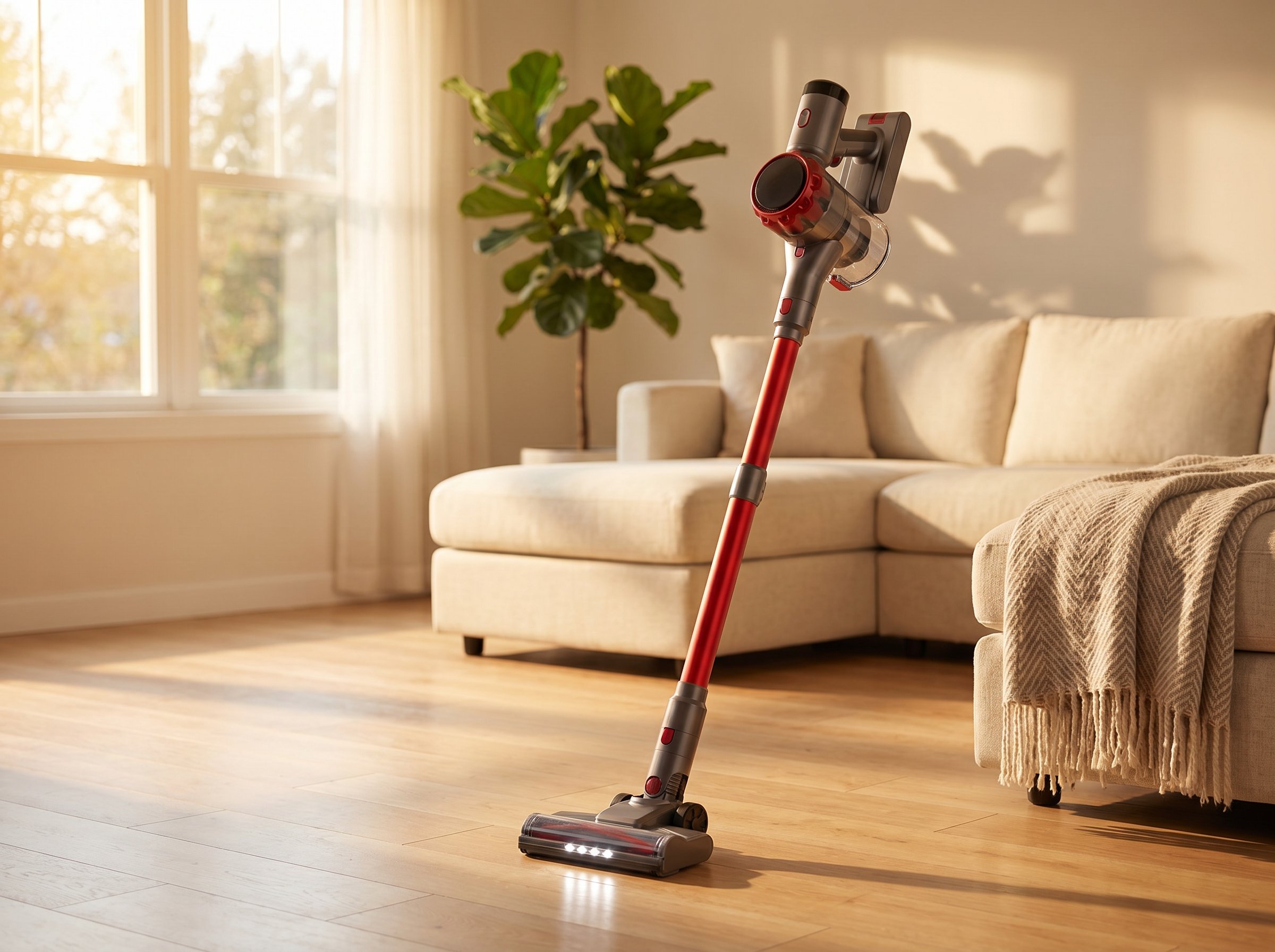
Then I bought one.
I want to walk you through why it survived my list — because the list was the whole point of this investigation, and I'm not going to pretend it wasn't.
And then the part of the spec sheet that made me actually order it: suction power of 35 kPa. For context, the $700 premium vacuum I had owned was rated at 22 kPa. The Nyven, at $129.99, had over 50% more raw suction power than the machine that had cost me almost six times as much.
I figured: at this price, with that spec sheet, it's worth $129.99 to find out whether it's real.
30 Days Later
I have now been using the Nyven S3P every day for thirty-one days. I told myself when I bought it that I would write this report regardless of how it performed — because the investigation was the point, not the product recommendation.
Here is what I can tell you, honestly.
The suction is real. The first time I ran it, I vacuumed my living room — a room I had "cleaned" two days earlier with the dying premium vacuum before it gave out. The Nyven's dustbin filled with a visible layer of fine gray dust, dog hair, and what I think was crumbled potato chip from approximately 2023. The machine I had paid $700 for had been spitting half of that back at me for years.

The weight is real. 4.4 pounds is genuinely as light as it sounds. I can lift it overhead with one hand to clean the tops of cabinets without my forearm shaking. My mother, who is 71 and has arthritis, picked it up at my house last week and said, "Wait, this is a vacuum?"
The battery is real. I have done a full 1,400 sq ft clean — kitchen, living room, hallway, three bedrooms — on a single charge, with battery to spare. On the box it says 55–60 minutes. I have not yet seen it drop below 50 minutes of usable runtime in normal mode.
The anti-tangle brush is real. Thirty-one days, one shedding dog, my own shoulder-length hair. I have not pulled a single tangle out of the brushroll. With my old vacuums, that was a weekly chore involving scissors. With this one, it has simply not happened.
What I do not love, in the interest of being fair:
The LED headlights are good but they are not the sci-fi green laser show that premium brands use as a centerpiece. They are functional. They show you dust. They do not look like a Tesla.
The packaging is plain. Brown cardboard, minimal printing, no glossy unboxing experience. This is a value-priced brand and it shows in the box. I personally do not care — I bought a vacuum, not a piece of design furniture — but if a beautiful unboxing matters to you, that is not what you are getting.
And it is not a household name. You will not find it at Best Buy. The brand is direct-to-consumer, which means you order it, it ships to you, and that's the entire transaction. After the customer service runaround I got from my old premium brand when it died, I personally find this refreshing. But it is different.
What I Would Tell Anyone Asking
I spent a month investigating the premium cordless vacuum category because I had been burned twice and I wanted to understand why.
What I found is that the premium cordless vacuum, as a category, has converged on a set of design choices — glued housings, non-balanced battery packs, proprietary battery shapes that change every two years, and warranty fine print that requires expensive recurring purchases — that make these machines fundamentally disposable. The marketing has not caught up to this. The price tags have not caught up to this. But the engineering has.
I am not telling you to throw out a vacuum that's still working. I am not telling you that every premium brand is a scam, because that's not what I found and it's not what I believe.
What I am telling you is that if you are about to spend $400, $600, or $800 on a cordless vacuum, you should know what you are paying for. You are paying for marketing budgets, retail shelf space, celebrity-grade industrial design, and a set of engineering decisions that benefit the manufacturer's repeat-purchase business model more than they benefit you.
You can buy a vacuum that doesn't do that. It costs $129.99. It has been the best $129.99 I've spent on a household appliance in a decade.
That is the entire report.